Loading page

Explore prepaid travel eSIM plans across 180+ countries. Browse by region, country or coverage type and choose between local, regional and global eSIM plans.
Know exactly what you need? Use Advanced Search to filter by destination, data, validity and price.
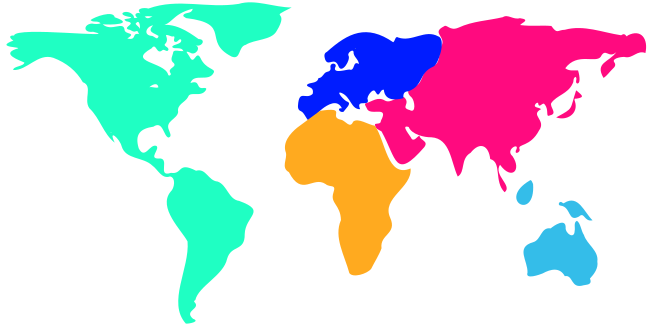
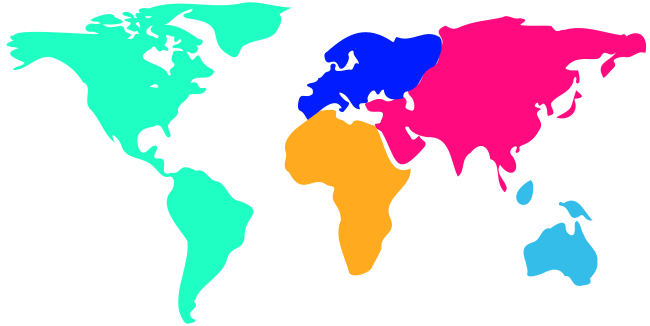
Start where you're going. Each region opens onto its countries and the plans that cover them.
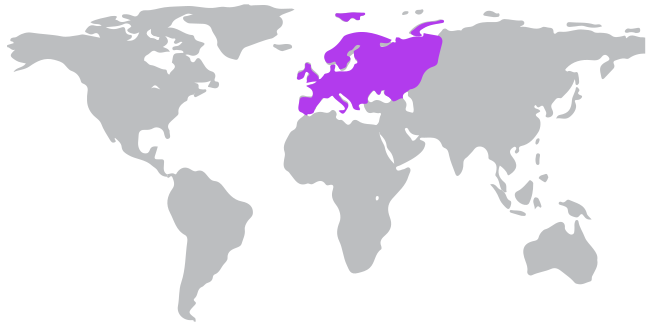
Schengen-friendly bundles, single-country EU & UK plans, and Balkan passes.
Japan, Thailand, China, India, Southeast Asia, and multi-country Asia passes.
Local USA & Canada plans plus Mexico and cross-border bundles.
UAE, Saudi Arabia, Oman, and GCC-focused regional packages.
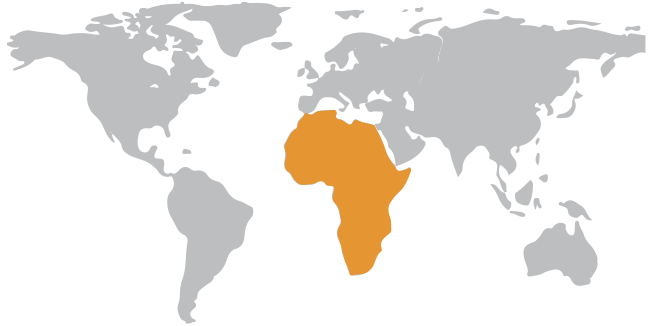
Safari hubs, business cities, and pan-Africa bundles where available.
Brazil, Argentina, Chile, and Latin America regional options.
Australia, New Zealand, and Pacific island coverage.
Island-hopping and cruise-friendly prepaid data.
Worldwide and global roaming-style bundles for multi-continent trips.
Regional bundles that span several countries in one QR.
The difference between them is geography, not quality — pick the one that matches your route.
Dedicated data on a local network for one destination, usually the best price-per-gigabyte.
Best for: One-stop trips and longer stays in a single country.
One eSIM that follows you across a whole continent — Europe, Asia, the Gulf, and more.
Best for: Multi-country itineraries, rail trips, and cruises.
A single plan that stays connected across continents on partner networks worldwide.
Best for: Round-the-world routes and frequent flyers.
The best-stocked destinations in the catalog right now.
A cheap, varied sample from across the whole catalog.









Route, allowance, validity, activation — get these right and the rest takes care of itself.
01
One country, a regional bundle, or a global pass — start from where you are going.
02
Maps and messaging are light; video and hotspot are heavy. Aim for ~1 GB per travel day.
03
Make sure the validity window comfortably covers your full trip, activation to departure.
04
Your QR arrives instantly — install on Wi-Fi before you fly and switch on data when you land.
This page is a directory — browse by region, coverage type or popular destination to get oriented. Search is the filter tool: narrow every plan in the catalog by destination, data, trip length, network and price in one pass.
Every plan page lists its coverage countries in full. Bundles named after a continent rarely cover all of it, so check the list against your itinerary before buying.
Most recent iPhones, Google Pixel devices, and many Samsung models support eSIM. Check your handset settings or our compatibility page before purchase; the product detail page also lists activation steps.
After checkout we email delivery instructions immediately for most plans. Open the product page for timing nuances or validity windows.