
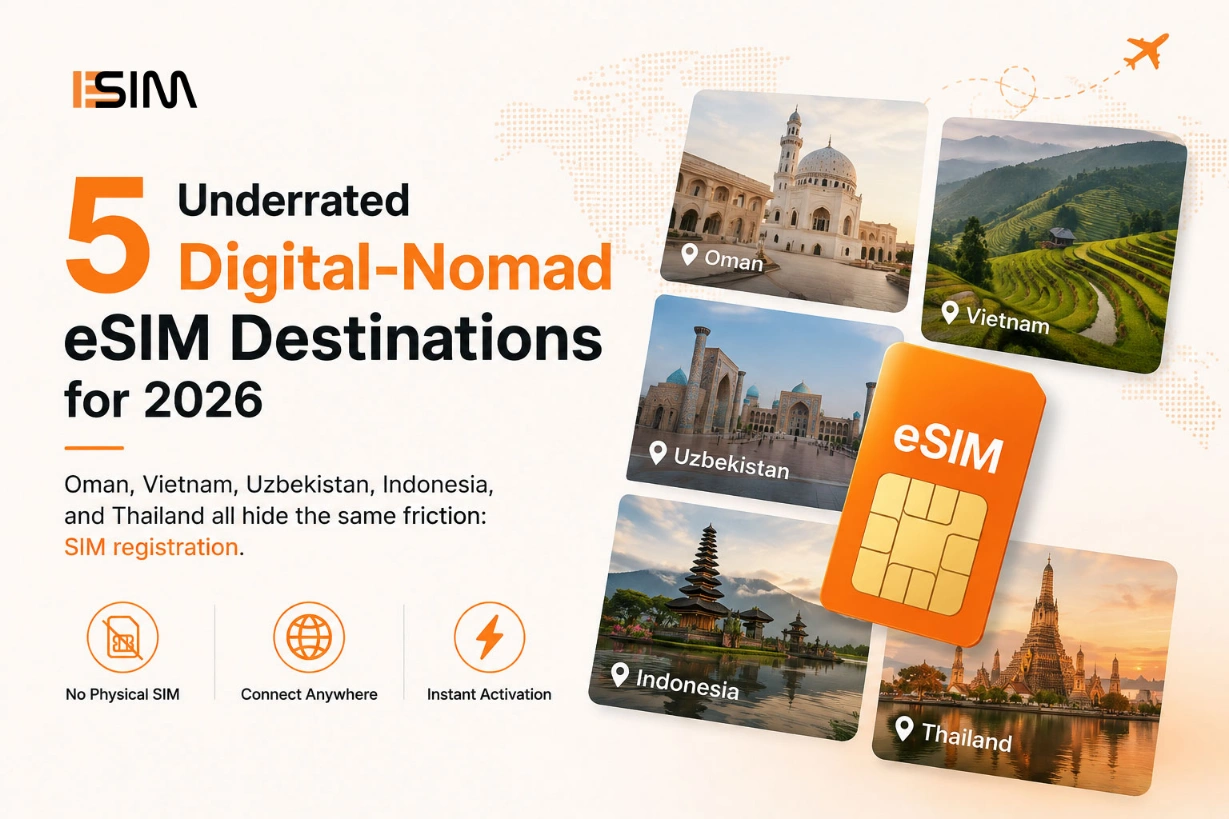
5 Underrated Digital-Nomad Destinations Where an eSIM Quietly Saves Your Trip
In Oman, Vietnam, Uzbekistan, Indonesia, and Thailand, a local SIM can mean a passport scan, a queue, and a language barrier. Here is where arriving with a travel eSIM already loaded changes the whole first day — with real plan sizes and prices.
- 5 nomad bases
- No SIM registration
- Real plans & prices
- Instant eSIM setup
Key takeaways
- The friction is registration, not price — local SIMs in these countries require a passport scan, a photo, and a national-database entry; an hour lost if anything goes wrong.
- An eSIM sidesteps the counter — buy before you fly, scan a QR code at home on Wi-Fi, and connect the moment you land.
- 10–20 GB covers a working month — for most remote-work stays, a 30-day 10 GB or 20 GB local plan is the sweet spot.
- Regional plans cross borders — a Southeast Asia bundle keeps one profile active across Thailand, Vietnam, and Indonesia.
Most connectivity guides tell you the same thing about the same places: get a SIM in France, grab one in Singapore, you're fine. And you are — those countries make it easy.
The destinations that actually reward planning ahead are the ones nobody warns you about: places where a local SIM means a passport scan, a photo, a queue, a language barrier, and sometimes a shop that simply won't sell to a foreigner because its till isn't set up for it. In those places, the humble travel eSIM stops being a convenience and becomes the difference between working the afternoon you land and losing it to a kiosk.
Here are five emerging bases where that gap is widest — and where arriving with data already loaded on your phone changes the whole first day.
Why SIM registration is the real friction (not price)
Across most of Asia and the Middle East, buying a physical SIM is no longer a grab-and-go purchase. Governments have tied every mobile number to a verified identity to cut down on fraud and anonymous scam traffic.
In practice, that means a mandatory registration step: staff scan or photograph your passport, sometimes take your photo, enter you into a national database, and only then activate the card. When it works, it takes five to ten minutes. When it doesn't — busy airport, no English at the counter, a system that rejects foreign passports, a “pre-activated” street SIM that dies after two days — it eats an hour or an afternoon.
5–10 min
If registration works
1 hr+
If it goes wrong
0
Counters with an eSIM
On landing
When you get online
OmanMiddle East
 Oman
OmanOman has quietly become one of the Gulf's most appealing bases for remote workers. Cost of living undercuts the UAE, safety and infrastructure are comparable, and Muscat, Nizwa, and the coastline stay refreshingly uncrowded next to Dubai. A remote-work visa launched in recent years has only accelerated the trend.
What to load before you fly
For a working week or two in Muscat with navigation and video calls, a mid-size local plan is the sweet spot — a 10 GB / 30-day profile. Longer, hotspot-heavy stays scale cleanly to 20 GB or 50 GB. If Oman is one leg of a Gulf hop, a regional GCC plan covers the UAE, Qatar, and Saudi Arabia too.
| Plan | Data | Validity | Price | Best for |
|---|---|---|---|---|
| Oman 5GB 30Days OM_5_30 | 5 GB | 30 days | $15.40 | A light working week on the Omantel network. |
| Oman 10GB 30Days OM_10_30Best value | 10 GB | 30 days | $28.16 | The sweet spot for a working week or two in Muscat. |
| Oman 20GB 30Days OM_20_30 | 20 GB | 30 days | $51.70 | Hotspot-heavy or longer coastal stays. |
| Oman 50GB 30Days OM_50_30 | 50 GB | 30 days | $85.56 | Heavy tethering across a full month. |
All Oman eSIM plans
Strong Omantel coverage from desert roads to the coast. Top pick: OM_10_30 — 10 GB for 30 days at $28.16.
VietnamSoutheast Asia
 Vietnam
Vietnam isn't underrated as a destination — Da Nang, Hoi An, and Ho Chi Minh City have mature co-working scenes and mobile data that out-benchmarks a lot of European cities. It's underrated as a base, and the reason is precisely the friction we're talking about.
What to load before you fly
Vietnam's local data is some of the cheapest in the region, which carries straight over to eSIM pricing. A 30-day 10 GB or 20 GB plan covers a comfortable working month for very little. Pairing Vietnam with Thailand or Indonesia? A Southeast Asia regional plan means one profile for the whole loop.
| Plan | Data | Validity | Price | Best for |
|---|---|---|---|---|
| Vietnam 5GB 30Days VN_5_30 | 5 GB | 30 days | $8.29 | A lean working month in Da Nang or HCMC. |
| Vietnam 10GB 30Days VN_10_30Best value | 10 GB | 30 days | $15.14 | A comfortable working month at Vietnam's low data prices. |
| Vietnam 20GB 30Days VN_20_30 | 20 GB | 30 days | $27.79 | Video calls and hotspot without watching the meter. |
| Vietnam 50GB 180Days VN_50_180 | 50 GB | 180 days | $73.68 | Long, slow-travel stays across six months. |
All Vietnam eSIM plans
Fast, cheap data across Hanoi, Da Nang, and HCMC. Top pick: VN_10_30 — 10 GB for 30 days at $15.14.
UzbekistanCentral Asia
 Uzbekistan
Samarkand, Bukhara, and Khiva are drawing a new wave of slow travelers and remote workers, and Tashkent's real-world 4G speeds are perfectly workable. But Uzbekistan is where the local-SIM friction gets genuinely awkward.
What to load before you fly
Uzbekistan sits inside broader Central/Asia regional bundles, which are the easy answer here — a 20-area Asia plan covers Uzbekistan alongside neighbors like Kazakhstan and Kyrgyzstan if you're routing across the region. Lean toward a larger data bucket, since local video and maps usage adds up over a slow-travel month.
| Plan | Data | Validity | Price | Best for |
|---|---|---|---|---|
| Asia (20 areas) 3GB 15Days AS-21_3_15 | 3 GB | 15 days | $19.58 | A short Silk Road loop across the region. |
| Asia (20 areas) 5GB 30Days AS-21_5_30Best value | 5 GB | 30 days | $29.92 | Covers Uzbekistan plus Kazakhstan and Kyrgyzstan. |
| Asia (20 areas) 10GB 30Days AS-21_10_30 | 10 GB | 30 days | $50.60 | A slow-travel month with maps and video. |
| Asia (20 areas) 20GB 30Days AS-21_20_30 | 20 GB | 30 days | $70.00 | Heavy use across a multi-country Central Asia route. |
Uzbekistan & Central Asia coverage
One regional eSIM spans Uzbekistan and its neighbors. Top pick: AS-21_5_30 — 5 GB for 30 days at $29.92.
IndonesiaSoutheast Asia
 Indonesia
Bali and Yogyakarta are perennial nomad magnets, and for short stays Indonesia is easy enough. What trips people up is a second layer of bureaucracy most countries don't have: alongside passport-based SIM registration, Indonesia also polices device IMEI registration.
What to load before you fly
For a Bali working stint, a 30-day plan in the 10 GB–20 GB range covers daily work comfortably. If you're island-hopping across Southeast Asia, the same regional bundles that cover Vietnam and Thailand include Indonesia — one profile, no re-registration each time you cross a border.
| Plan | Data | Validity | Price | Best for |
|---|---|---|---|---|
| Indonesia 5GB 30Days ID_5_30 | 5 GB | 30 days | $5.94 | A frugal working month in Bali. |
| Indonesia 10GB 30Days ID_10_30Best value | 10 GB | 30 days | $10.34 | Daily work in Bali or Yogyakarta, comfortably. |
| Indonesia 20GB 30Days ID_20_30 | 20 GB | 30 days | $18.04 | Hotspot and video for a heavier month. |
| Indonesia 50GB 30Days ID_50_30 | 50 GB | 30 days | $37.40 | A big-data month with no customs IMEI queue. |
All Indonesia eSIM plans
Official-network data across Bali, Jakarta, and the islands. Top pick: ID_10_30 — 10 GB for 30 days at $10.34.
ThailandSoutheast Asia
 Thailand
Thailand is the opposite of underrated as a destination, but it earns a spot here because the friction is so easy to forget. With 35 million-plus annual arrivals, the airport SIM counters at Suvarnabhumi and Don Mueang are exactly as busy as you'd fear — and a tourist SIM still needs a passport, a working counter, and a physical swap.
What to load before you fly
Thailand eSIM plans are cheap and plentiful. A week of solid 4G/5G runs a few dollars; a 30-day plan sized to your data habits covers a working month. And because Thailand anchors most Southeast Asia regional bundles, it's the natural hub plan if your itinerary also touches Vietnam, Indonesia, or Malaysia.
| Plan | Data | Validity | Price | Best for |
|---|---|---|---|---|
| Thailand 1GB 7Days TH_1_7 | 1 GB | 7 days | $1.54 | A few dollars for a solid week of 4G/5G. |
| Thailand 5GB 30Days TH_5_30Best value | 5 GB | 30 days | $5.94 | Cheap, plentiful data for a working month. |
| Thailand 10GB 30Days TH_10_30 | 10 GB | 30 days | $10.34 | Maps, calls, and streaming across Bangkok. |
| Thailand 20GB 30Days TH_20_30 | 20 GB | 30 days | $18.04 | A heavier month without touching a counter. |
All Thailand eSIM plans
High-speed data from Bangkok to the islands. Top pick: TH_5_30 — 5 GB for 30 days at $5.94.
Regional plans for multi-country routes
Looping through several of these bases on one trip? A regional eSIM keeps a single profile active across borders instead of re-registering at every new country. The Southeast Asia bundle spans Thailand, Vietnam, Indonesia, Singapore, Malaysia, the Philippines, and Cambodia — one eSIM for the whole loop.
| Plan | Data | Validity | Price | Best for |
|---|---|---|---|---|
| Asia (7 areas) 5GB 30Days AS-7_5_30 | 5 GB | 30 days | $15.40 | One profile for a lighter multi-country loop. |
| Asia (7 areas) 10GB 30Days AS-7_10_30Best value | 10 GB | 30 days | $26.84 | Vietnam, Thailand, and Indonesia on a single eSIM. |
| Asia (7 areas) 20GB 30Days AS-7_20_30 | 20 GB | 30 days | $44.00 | Heavier data across the whole SE Asia circuit. |
| Asia (7 areas) 50GB 180Days AS-7_50_180 | 50 GB | 180 days | $75.00 | Six months of island- and city-hopping. |


The pattern worth remembering
The common thread across all five isn't price — local SIMs are often a touch cheaper per gigabyte. It's certainty.
In every one of these countries, the physical-SIM route carries a registration step that can quietly go wrong: a queue, a language gap, a passport-scan requirement, a system that won't accept a foreign document, a device rule you didn't know existed.
- 1
Buy before departure
An eSIM removes the variable. Purchase and install the QR code at home while you still have reliable Wi-Fi. - 2
Activate on landing
Most plans begin on first connection to a local network — not at purchase — so you arrive already online. - 3
Certainty beats a small saving
When your income depends on being online, skipping a registration queue is worth far more than the modest per-gigabyte difference. - 4
Match data to how you work
10–20 GB suits a normal remote-work month; step up to 50 GB if you tether a laptop or run frequent video calls.
Before you buy
- Confirm your phone is eSIM-compatible and carrier-unlocked.
- Most recent iPhones (XR and later), Google Pixels, Samsung Galaxy S20+, and many other devices support eSIM.
- Install the QR code at home on Wi-Fi; the plan activates on first connection to a local network after you land.
- Not sure your device is supported? Run our compatibility checker before checkout.
Frequently asked questions
In Oman, Vietnam, Uzbekistan, Indonesia, and Thailand, buying a physical SIM means a mandatory passport-based registration step — a scan, sometimes a photo, and a national-database entry. When it works it takes minutes; when it doesn't (busy airport, language barrier, a system that rejects foreign passports) it can cost an afternoon. An eSIM lets you buy online before departure and skip the counter entirely.
Skip the registration counter entirely
Keep reading
Local, Regional & Global eSIM Types
Choose the right plan structure for single-country vs multi-country nomad trips.
Read articleeSIM Use Cases & Selection
Match data allowance to how you travel — short breaks vs long-term nomad life.
Read articleHow to Set Up eSIM on Android
QR activation and data-line settings for Samsung, Pixel, and more.
Read articleDual eSIM: Home & Travel Lines
Keep your home number for OTPs while a travel eSIM handles all your data.
Read articleeSimTrip Team
Connectivity experts · travel tested