
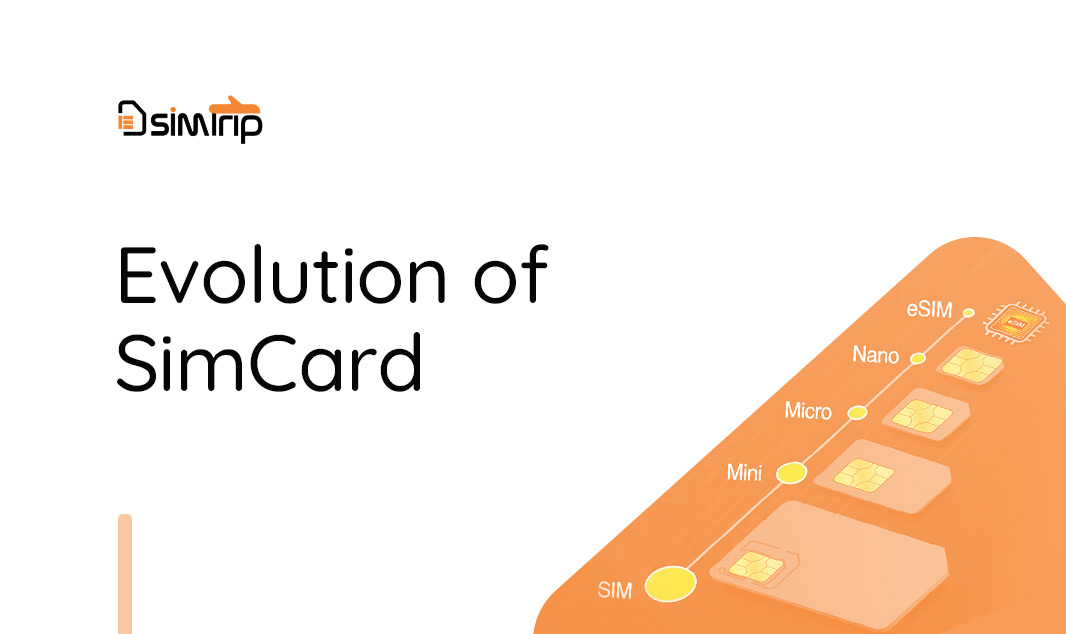
SIM Card Evolution: From Plastic Chips to Embedded Connectivity
Discover how SIM technology transformed from bulky plastic cards to seamless embedded profiles — and what this means for your connectivity, especially while traveling.
Key takeaways
- SIM cards evolved from credit-card size to fully embedded chips (iSIM).
- Each generation removed unnecessary plastic, freeing space for bigger batteries and better cameras.
- eSIM enables downloading carrier profiles remotely — perfect for travelers.
- iSIM integrates SIM directly into the phone's processor, unlocking new possibilities for IoT and wearables.
Evolution timeline (1991–today)
SIM sizes at a glance
The plastic around the metal contact pad never provided any electronic function. Reducing it gave phone makers more room for innovation. Here is how each form factor compares:
| Type | Dimensions (mm) | Year introduced | Notable devices |
|---|---|---|---|
| 1FF (Full-size) | 85.6 × 54 | 1991 | Early Nokia, Motorola bricks |
| 2FF (Mini-SIM) | 25 × 15 | 1996 | Nokia 3210, BlackBerry, iPhone original |
| 3FF (Micro-SIM) | 15 × 12 | 2003 | iPhone 4, Samsung Galaxy S3 |
| 4FF (Nano-SIM) | 12.3 × 8.8 | 2012 | iPhone 5+, most Android phones until 2020 |
| eSIM (embedded) | 6 × 5 (chip) | 2016 | iPhone XS/XR, Google Pixel 2, Samsung Galaxy S20 |
| iSIM (integrated) | < 4 mm² (inside SoC) | 2023+ | Qualcomm Snapdragon 8 Gen 2, future wearables |
Note: eSIM and iSIM are not removable; profiles are downloaded over the air.
Why SIM cards kept shrinking
The secure element inside a SIM — the chip that stores your subscriber identity and encryption keys — never needed the large plastic body around it. As phones became thinner and packed larger batteries, multi-lens cameras, and stronger antennas, every square millimeter mattered.
Shrinking the SIM gave engineers design flexibility: a smaller SIM tray or directly soldered chip allowed for higher battery capacity or reduced device thickness. The transition from Mini-SIM to Nano-SIM freed up about 74% of the footprint without changing the core security functions.
The shift from hardware to software
Physical SIM generations (1FF to 4FF) still required you to insert and swap cards manually. eSIM changed the game by moving profile delivery online. Instead of buying a plastic card, you scan a QR code or use an app to download a carrier profile. The identity remains just as secure, but activation becomes instant and remote.
Physical SIM
eSIM
iSIM
What this means for travelers
SIM evolution directly improves travel connectivity. With eSIM support, you can install a local data plan before departure, keep your primary number active for calls/SMS, and switch data lines in settings within seconds.
No more hunting for a local SIM kiosk, handling tiny adapters, or paying excessive roaming fees. eSIM puts a local data plan on your phone in under two minutes.
Check your device for eSIM
Most modern smartphones support eSIM, but compatibility depends on region and carrier unlocks. Use this simple checklist:
- iPhone: XS, XR, and newer (all models outside China mainland).
- Google Pixel: Pixel 3 and newer.
- Samsung Galaxy: S20/Note 20 series and later (regional variants).
- Other Android: Recent flagships from Motorola, Xiaomi, Huawei, Oppo — check spec sheet for “eSIM support”.
Before switching fully to eSIM
- Confirm your phone model and region variant explicitly support eSIM (check Settings > Cellular/Mobile).
- Ensure your device is carrier-unlocked if you plan to use foreign travel eSIMs.
- Keep a backup of the activation QR code or SM-DP+ address for future reinstallation.
- Check if your home carrier allows conversion from physical SIM to eSIM — most do via app or in-store.
The future: iSIM and beyond
While eSIM still requires a dedicated chip soldered onto the phone's circuit board, iSIM (Integrated SIM) goes further: the SIM functionality becomes part of the main processor (SoC). This integration saves space, reduces power consumption, and strengthens security because the identity is locked inside the trusted execution environment of the chip.
iSIM is expected to dominate wearables, IoT devices, and next-generation smartphones. For travelers, iSIM will mean even simpler activation and possibly more flexible subscription management, without any trade-off in battery life or storage.
Ready for a software SIM?
You might also like
eSimTrip Team
Connectivity experts · travel tested